
Electronics Engineering: Digital Systems Course Track
Electronics Engineering: Digital Systems Course Track
|
Track Mission Statement: |
1. The Curriculum Pathway & Big Picture Outcome
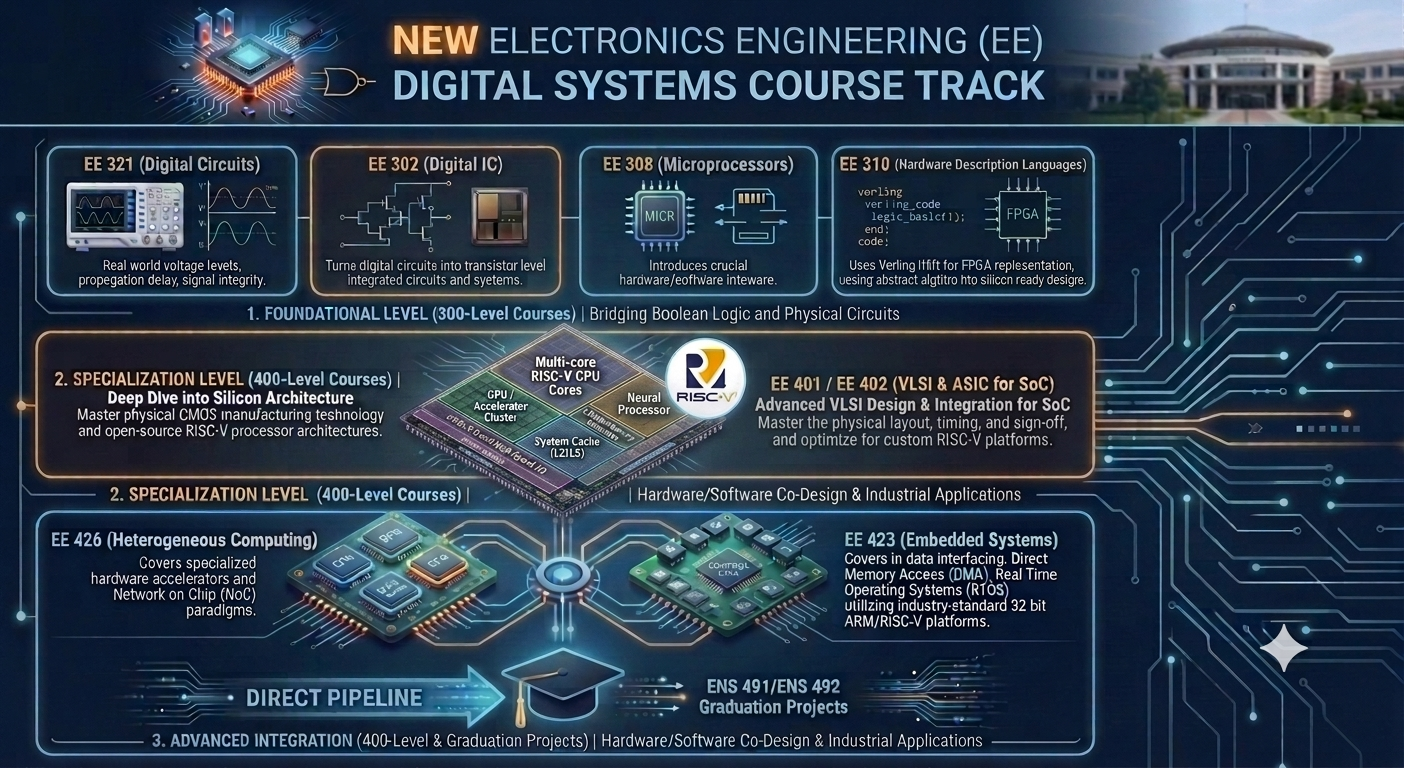
The track is structured as a vertical progression, moving logically from foundational electronics to advanced industrial-scale integration. The unified learning outcome bridges the critical intersection of physical hardware and digital computation into a structured pipeline.
Foundational Level (300-Level Courses)
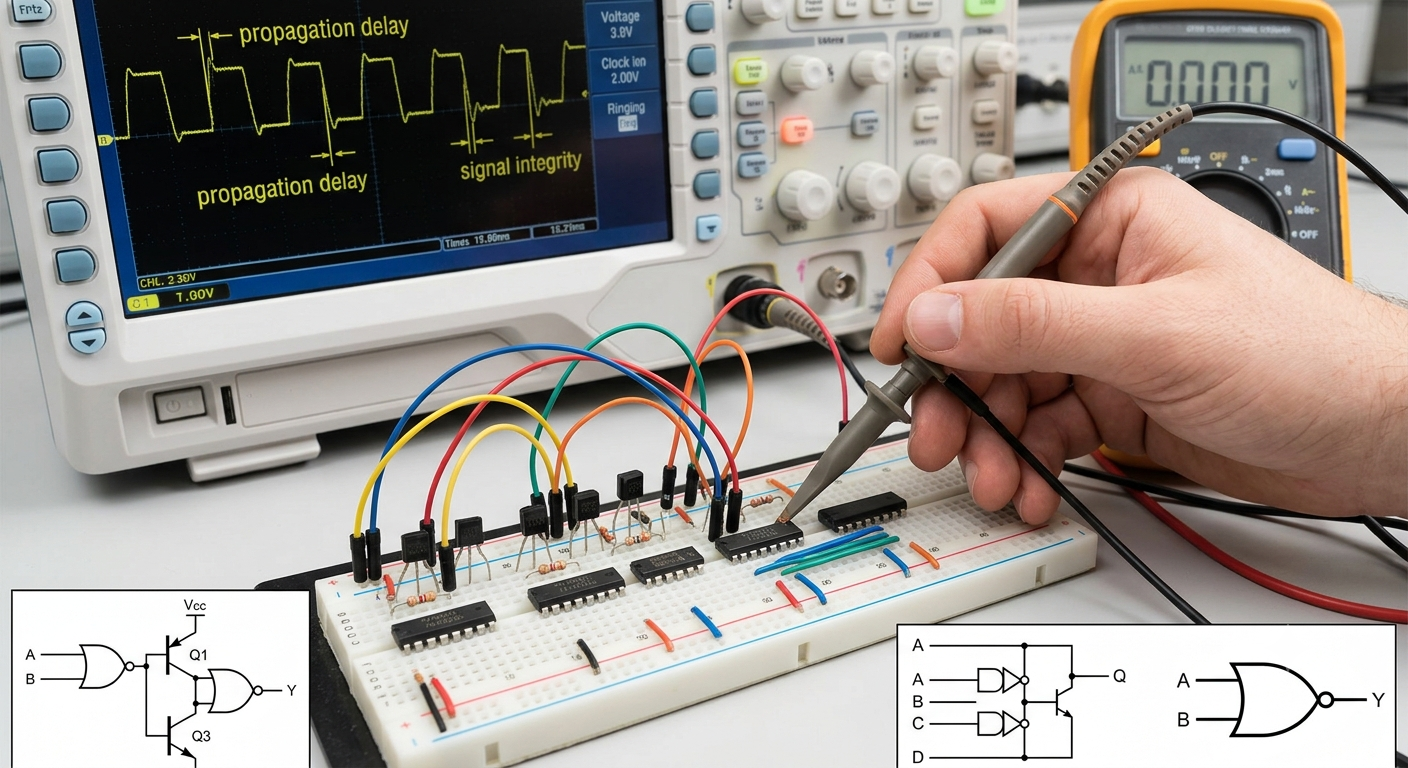
EE 321 (Digital Circuits): Moving Beyond Theory
Moves beyond abstract theory to teach real-world voltage levels, propagation delay, and signal integrity.
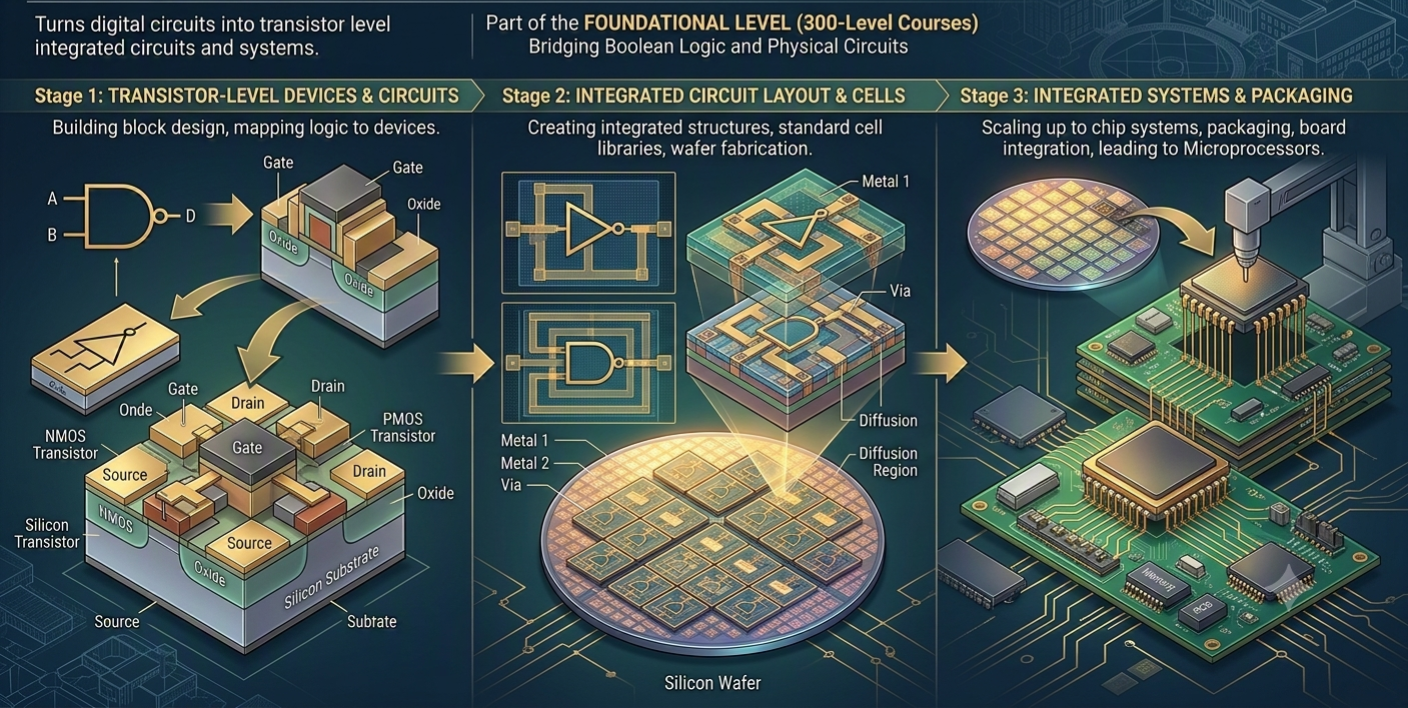
EE 302 (Digital IC): Turning digital circuits into Integrated Circuits (ICs)
Building block designs, mapping logic to devices, creating integrated structures, standard cell libraries and scaling up to chip systems.
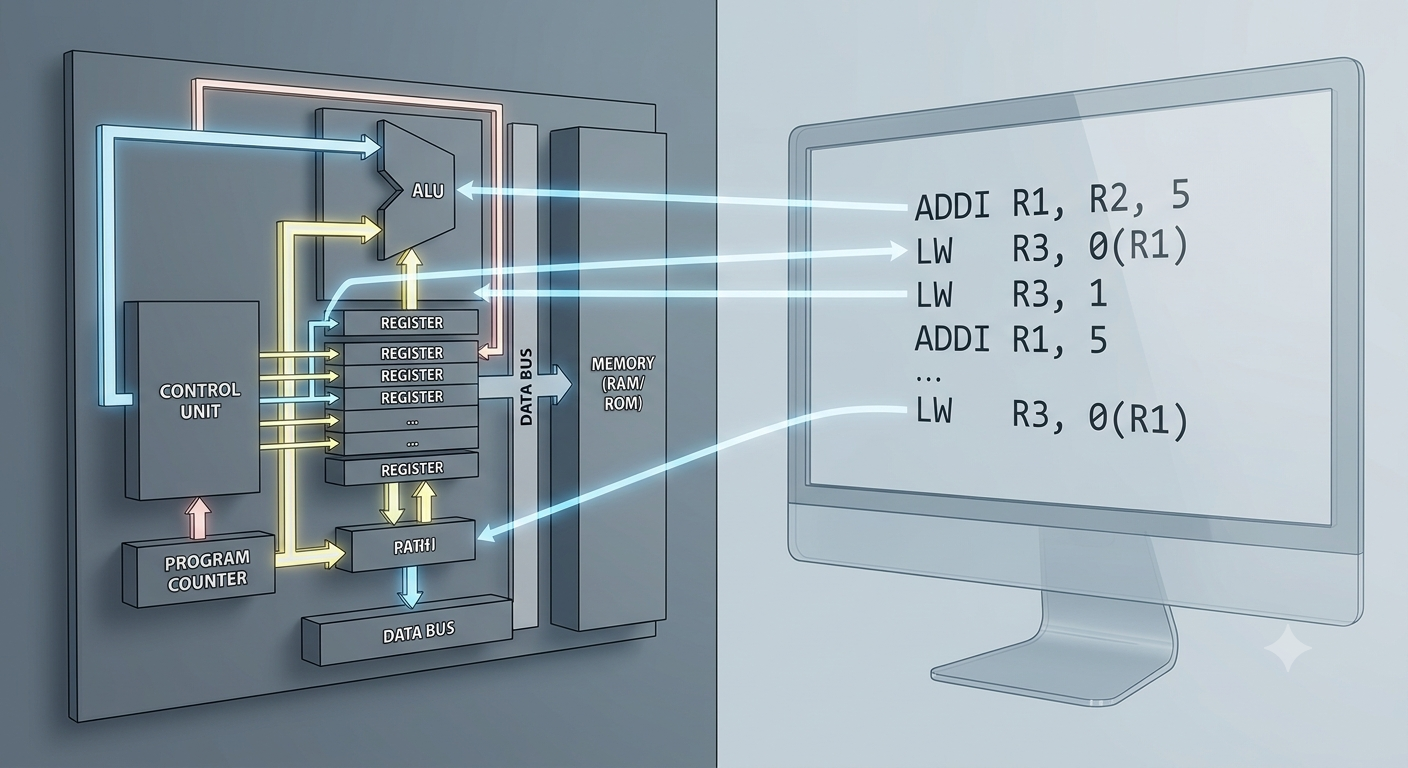
EE 308 (Microprocessors): The HW/SW Interface
Introduces the crucial hardware/software interface mapping abstract assembly code instructions directly to physical execution flow inside the CPU architectures.
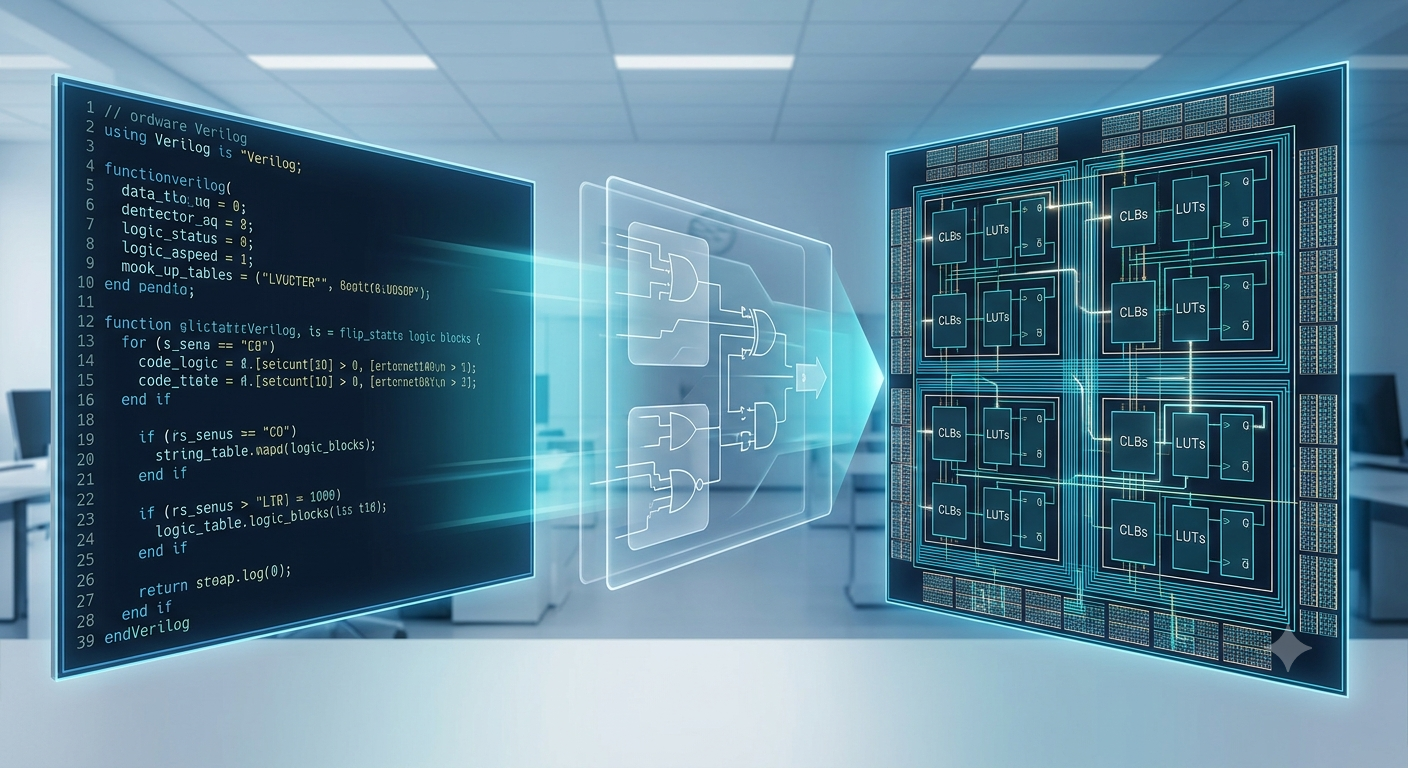
EE 310 (Hardware Description Languages): Abstract to Silicon-Ready
Uses Verilog/HDL for FPGA implementation, turning abstract algebra and logical blocks into concrete silicon-ready designs.
Specialization Level (400-Level Courses)
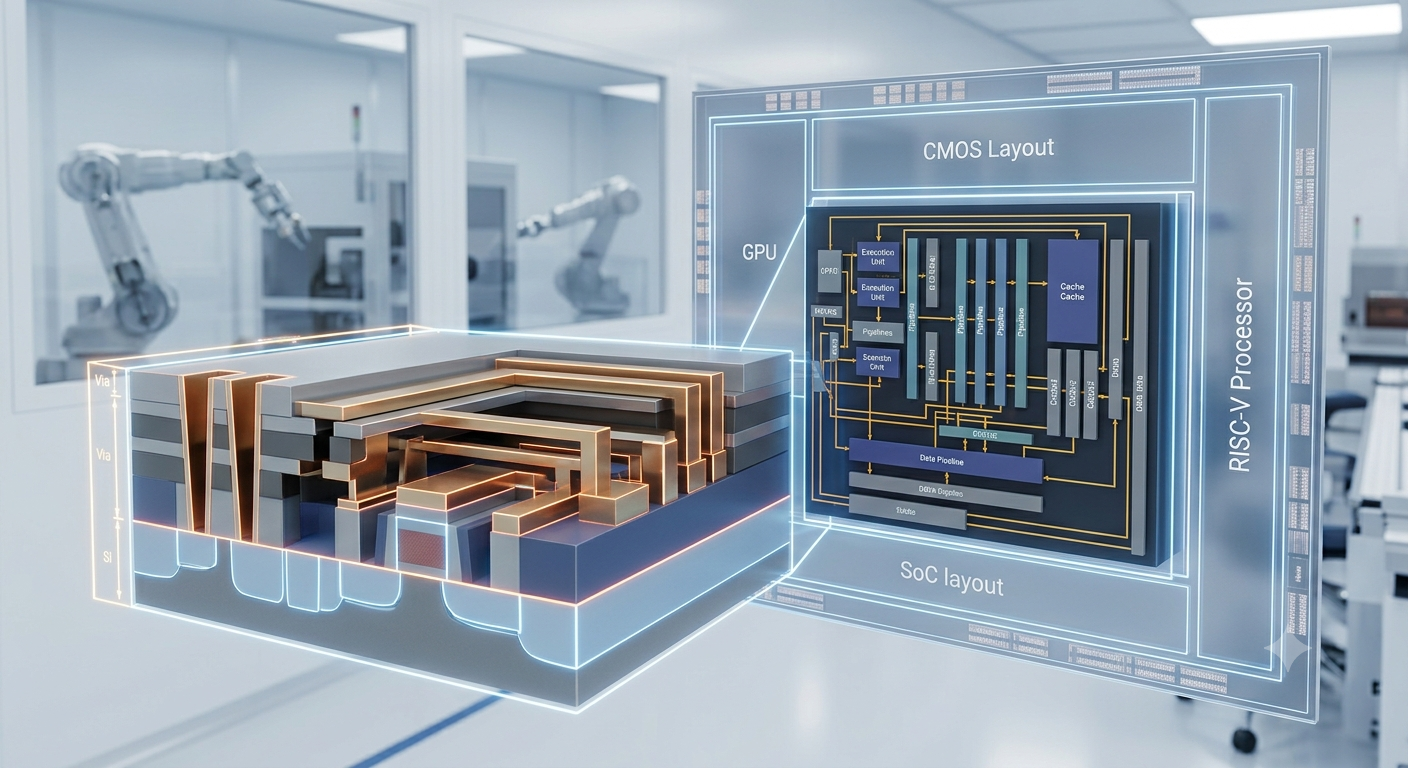
EE 401 / EE 402 (VLSI & ASIC for SoC): Deep Dive into Silicon Architecture
Master physical CMOS manufacturing technology along with modern open-source RISC-V processor architectures, enabling comprehensive mastery from physical layers up to systemic integration.
Advanced Integration & Graduation Projects
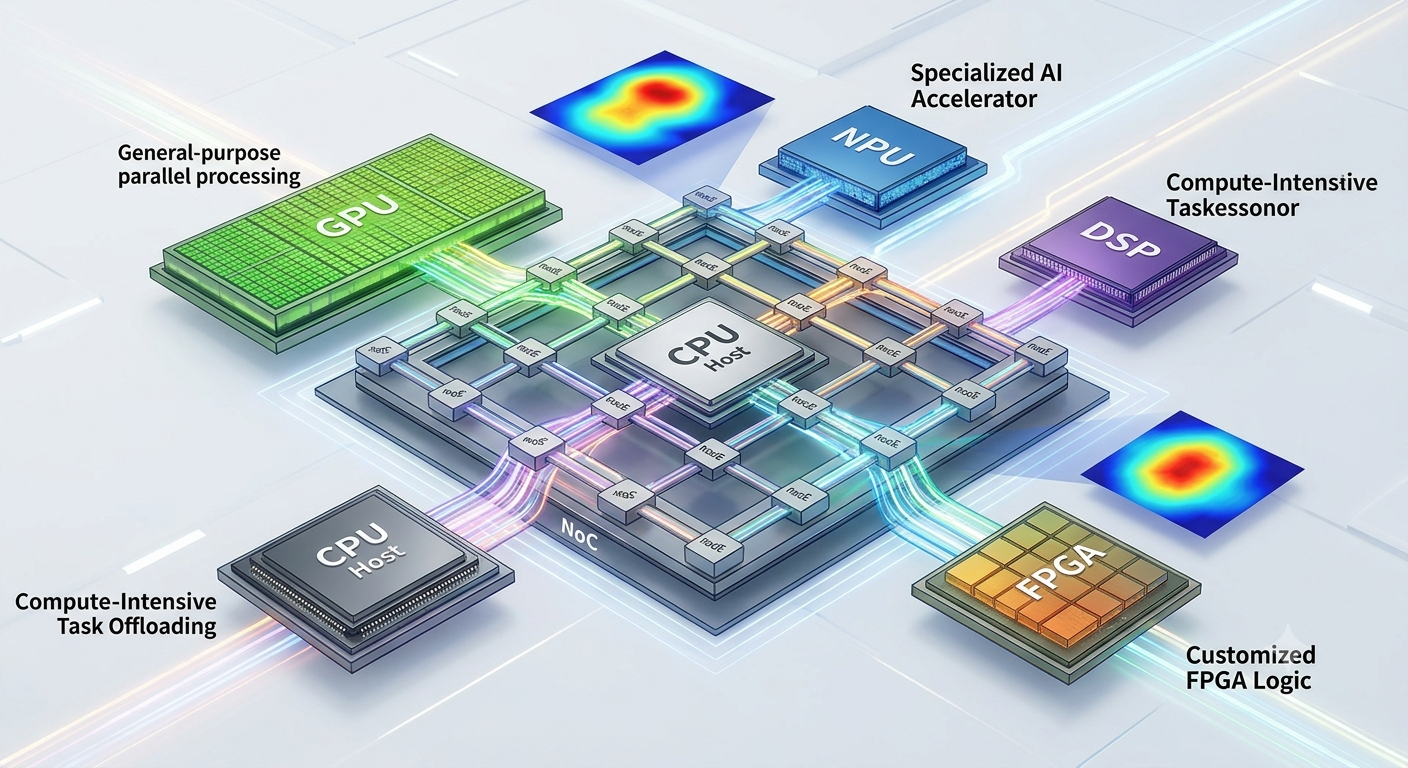
EE 426 (Heterogeneous Computing): Accelerators & Network-on-Chip
Covers highly specialized hardware accelerators (GPUs, NPUs, DSPs) and data-routing Network-on-Chip (NoC) paradigms necessary for scaling compute structures.
EE 423 (Embedded Systems): Real-Time Systems & Interfacing
Focuses on high-data-rate interfacing, Direct Memory Access (DMA), and Real-Time Operating Systems (RTOS) utilizing industry-standard 32-bit ARM or RISC-V microcontrollers.
Direct Pipeline Notice: This advanced integration phase directly prepares you for and feeds straight into your ENS 491 / ENS 492 Graduation Projects.
2. Important Degree Requirement Update: EE 321 vs. CS 303
Critical Notice: The newly introduced EE 321 (Digital Circuits) course is now a required course for EE students, replacing the previous CS 303 requirement. To ensure a smooth transition, a temporary grace period is active:
- EE students admitted before the 2026-2027 academic year: EE students may take either EE 321 or CS 303 to satisfy this requirement. However, taking EE 321 is highly recommended if you intend to follow the recently announced “Digital Systems Course Track”, as it provides the critical physical circuit background necessary for the 400-level sequence.
-
Moving Forward: EE students admitted in/after the 2026-2027 academic year, CS 303 will be completely removed from the EE required course list, making EE 321 strictly mandatory.
3. Faculty & Advising Contacts
For enrollment advising, comprehensive curriculum planning, or graduation project alignment, please reach out to the faculty members heading this track:
- Ayhan Bozkurt (Track Advisor)
- Özcan Öztürk (Faculty Lead)
- Ömer Ceylan (Faculty Lead)