
The scientific arXiv is now 30 years old. It started in 1991 as a "high energy physics theory" archive, and expanded in three decades to contain essentially all branches of science and engineering, not excluding the economics. It has catalyzed launch of bioRxiv and medRxiv. The arXiv has restructured and speeded up the dissemination of new research results. Its founder, Paul Ginsparg of the Cornell University, opines that "... preprint dissemination is no longer heterodox and the current trend of increased spread is unlikely to reverse", and "... spike in preprint use most relevant for questions about information sharing in wider society is the growth in bioRxiv and medRxiv triggered by the COVID-19 pandemic. These preprint archives hosted more than 10,000 articles in the pandemic's first year ..." [1].
In the last 30 years, arXiv has been the main open science platform, and will continue to be so with the aim of maximizing “research impact by making arXiv’s vast scientific content highly accessible and interoperable for the benefit of the community” [2]. The new submissions to arXiv, year by year, reveal not only the rise of the global research activity but also the change in the hot research topics. Indeed, as plotted in Figure 1 below, certain fields like mathematics, computer science and basic physics are becoming hotter research fields compared to the others.
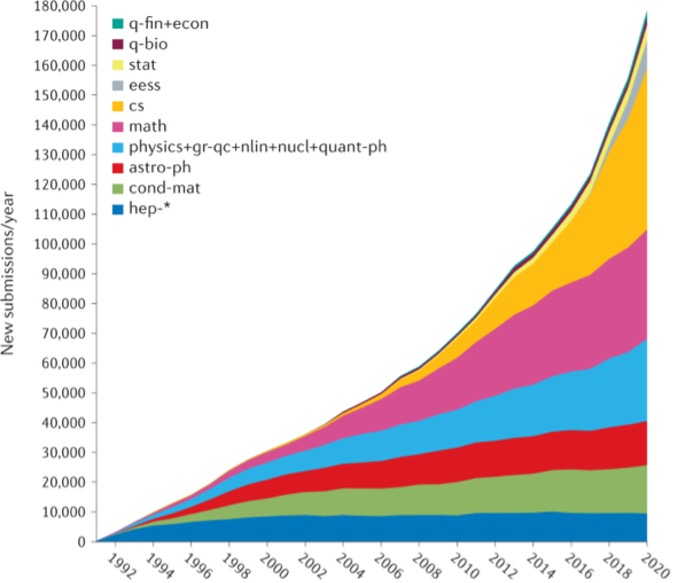
Figure 1. Yearly preprint submissions to arXiv since
1991 (taken from Ref. [1]).
[1] Ginsparg, P. 2021. “Lessons from arXiv’s 30 years of information sharing”, Nature Reviews Physics, 3, 602-603.
[2] arXiv blog: https://blog.arxiv.org/2021/08/13/celebrating-arxivs-30th-anniversary/